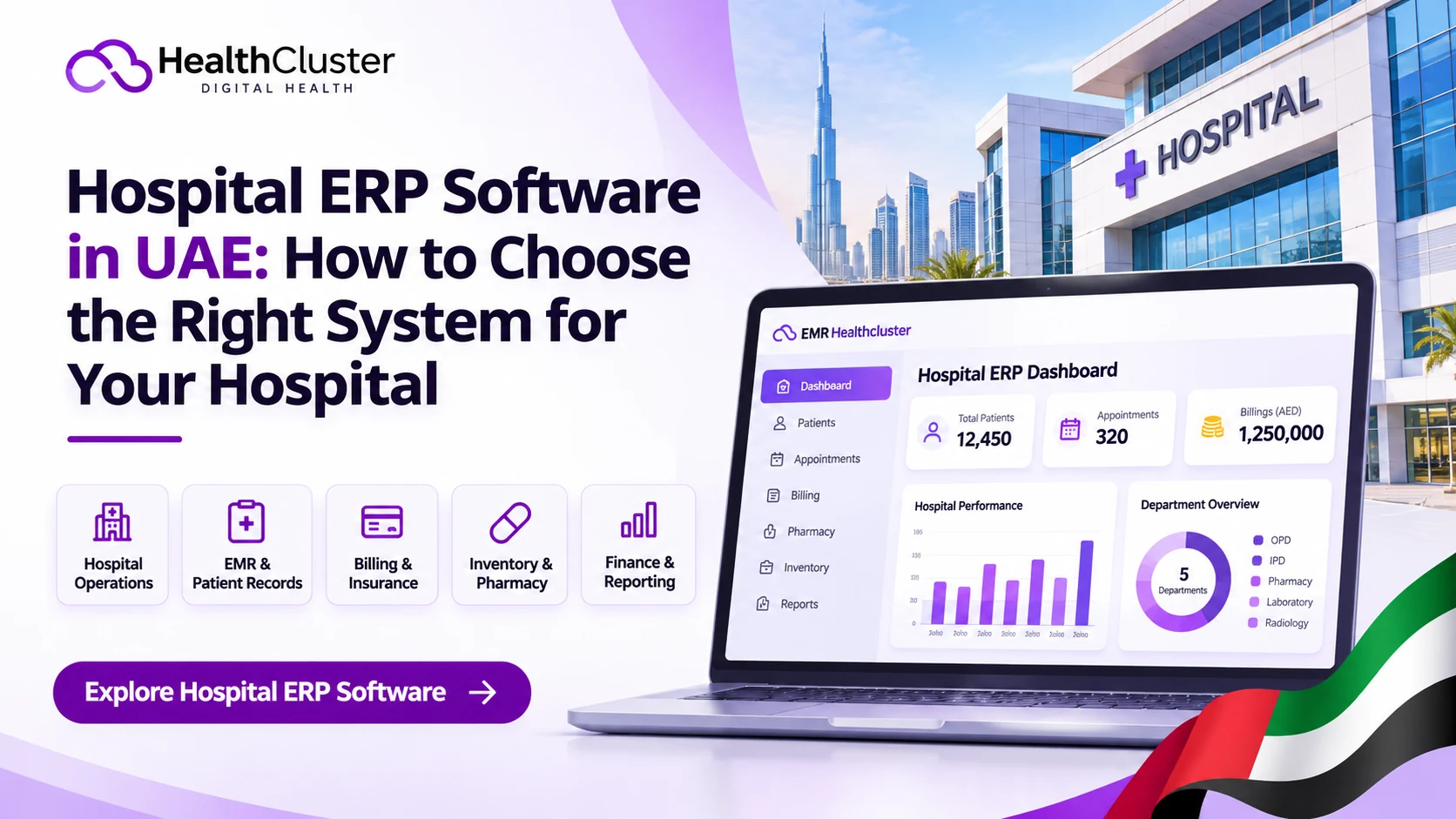
Hospital ERP Software in UAE: Choose the Right System for Your Hospital
Manage hospital operations, patient records, billing, inventory and financial workflows with the right integrated hospital ERP software. Discover what UAE hospitals should look for before investing in a healthcare management system.
✓ Hospital Operations ✓ EMR ✓ Billing ✓ Integrated Workflows
What Should Your Hospital ERP Manage?
- Patient registration and administration
- Electronic medical records
- Finance and accounting
- Insurance and medical billing
- Pharmacy and inventory
- Laboratory and radiology workflows
- Procurement and reporting
What Is Hospital ERP Software?
Running a hospital involves managing hundreds of interconnected activities. From patient registration and clinical documentation to procurement, pharmacy, billing, insurance and financial reporting, every department depends on accurate information.
Hospital ERP software is a digital platform that helps healthcare organizations manage their administrative, financial and operational processes through connected systems. Healthcare-focused ERP environments may also integrate with Hospital Information Systems (HIS) and Electronic Medical Records (EMR).
For hospitals in the UAE, an integrated solution can help improve operational visibility, reduce disconnected workflows and support better coordination between departments.
Looking for a complete hospital solution? Explore Health Cluster Hospital Management Software to discover connected hospital management capabilities.
Why Do Hospitals in the UAE Need ERP Software?
Connected systems help healthcare organizations manage complex operations and maintain better visibility across departments.
Connected Departments
Connect patient administration, finance, pharmacy, laboratory and other departments through coordinated digital workflows.
Better Financial Control
Monitor revenue, expenses, supplier payments, departmental costs and financial transactions.
Inventory Visibility
Manage medical supplies, medicines, stock levels, purchasing activities and inventory movements.
Insurance Workflows
Connect billing, clinical documentation, eligibility and claims-related processes where supported.
Improved Reporting
Give management teams access to relevant operational, financial and departmental reports.
Operational Efficiency
Reduce repetitive data entry and improve coordination between teams through integrated workflows.
Essential Features of Hospital ERP Software
Evaluate the modules that support your hospital’s daily clinical, financial and administrative activities.
Hospital Financial Management
Manage accounting, accounts payable, receivable, expenses, revenue tracking and financial reports.
Patient Administration
Coordinate patient registration, appointments, check-in, demographics and visit management.
Electronic Medical Records
Maintain medical history, diagnoses, physician notes, prescriptions, orders and clinical documentation.
Pharmacy Management
Manage medication inventory, dispensing, stock transfers, batch information and expiry tracking.
Laboratory Management
Connect laboratory orders, sample workflows, test results and patient records.
Medical Billing & RCM
Support billing, insurance workflows, claims management, payment tracking and revenue visibility.
Procurement & Inventory
Manage suppliers, purchase requests, purchase orders, stock levels and inventory reports.
HR & Workforce Management
Centralize employee records, staff assignments, attendance and relevant workforce administration.
Reporting & Analytics
Monitor patient activity, financial performance, departmental operations and business KPIs.
Hospital ERP vs HIS vs EMR: What Is the Difference?
ERP, HIS and EMR are often mentioned together when hospitals evaluate digital healthcare solutions. However, they serve different purposes.
| System | Main Purpose | Typical Functions |
|---|---|---|
| Hospital ERP | Enterprise operations | Finance, HR, procurement, inventory and reporting |
| HIS | Hospital management | Patient administration, billing, departments and workflows |
| EMR | Clinical documentation | Medical history, diagnoses, prescriptions and clinical notes |
| EHR | Electronic health records | Broader longitudinal patient health information and exchange |
Which System Does Your Hospital Actually Need?
A hospital may need ERP for business operations, HIS for hospital-wide management and EMR for clinical workflows. Some healthcare platforms combine multiple capabilities, reducing the need to operate disconnected applications.
Before purchasing software, identify which departments need to be connected and whether your existing systems can exchange information reliably.
Explore Hospital EMR Software to learn more about digital patient records and clinical management.
What Are the Top 5 Hospital ERP Software Companies?
These are five established enterprise software providers worth evaluating. They are not presented as a definitive UAE hospital ERP ranking.
1. Oracle
Oracle offers enterprise resource planning capabilities covering financial management, procurement and other business operations. Healthcare organizations may evaluate its enterprise solutions for complex operational requirements.
2. SAP
SAP provides enterprise platforms for finance, procurement, supply chain and business management. Its solutions may be relevant to large healthcare groups.
3. Infor
Infor offers enterprise software and industry-focused cloud solutions, including capabilities for supply chain and organizational operations.
4. Microsoft Dynamics 365
Microsoft Dynamics 365 provides finance, supply chain and business applications that organizations can evaluate for their enterprise workflows.
5. Workday
Workday focuses on financial management, human capital management and enterprise planning for organizations with workforce and financial management needs.
How to Compare Vendors
Compare healthcare suitability, implementation partners, integration options, local support, total cost of ownership and the modules your hospital actually needs.
Note: ERP vendors differ in their healthcare-specific capabilities. Confirm the exact product, implementation scope and availability in the UAE directly with each provider.
What Software Do Most Hospitals Use?
Hospitals typically use multiple software systems to manage clinical, administrative and financial operations. The exact combination depends on the facility’s size, specialties, infrastructure and digital strategy.
Common Hospital Software Categories
- HIS: Manages hospital-wide workflows and patient administration.
- EMR/EHR: Maintains patient medical records and clinical documentation.
- ERP: Manages finance, procurement, inventory and workforce operations.
- LIS: Supports laboratory orders, samples and results.
- RIS/PACS: Manages radiology workflows and medical imaging.
- RCM: Supports billing, insurance and revenue cycle processes.
- Pharmacy Management: Supports medication inventory and dispensing.
Some hospitals use different vendors for each system, while others select integrated platforms that connect multiple departments.
Consider an integrated approach. Explore Health Cluster Hospital Management Software to see how clinical and administrative workflows can be connected.
What Are the Top 5 EHR Systems?
These are notable EHR providers in the global healthcare technology market, rather than a universal ranking.
1. Epic
Epic is widely recognized for its electronic health record platform, particularly among large healthcare organizations.
2. Oracle Health
Oracle Health provides healthcare technology and electronic health record solutions for healthcare organizations.
3. MEDITECH
MEDITECH offers electronic health record and hospital information system capabilities.
4. InterSystems
InterSystems provides healthcare data platforms and clinical information system technologies.
5. Dedalus
Dedalus offers healthcare information systems and digital health solutions across multiple markets.
Evaluate Local Suitability
Check implementation support, interoperability, hosting, applicable UAE requirements and integration capabilities before choosing an EHR.
What Should UAE Hospitals Consider Before Choosing ERP Software?
Healthcare providers in the UAE should evaluate more than software features and pricing. The system must fit the organization’s location, operational scope, applicable regulatory requirements and integration environment.
1. Healthcare Authority Requirements
Requirements can vary depending on where the healthcare facility operates. Hospitals should assess the relevant authority and applicable healthcare information exchange requirements.
- Dubai: Consider relevant DHA requirements and NABIDH integration requirements.
- Abu Dhabi: Assess applicable Department of Health requirements and Malaffi-related integration requirements.
- Other UAE Emirates: Assess the relevant MOHAP or local authority requirements, including applicable Riayati requirements.
Confirm the exact integration scope, technical specifications and applicable approvals with the software vendor and relevant authority.
2. Data Security and Hosting
Ask vendors about hosting location, access controls, encryption, audit trails, backup arrangements, disaster recovery and applicable healthcare data protection requirements.
3. Healthcare Interoperability
Check whether the software supports the interfaces and data exchange standards needed by your hospital and its connected systems. Do not assume that every vendor supports every integration or standard.
4. Local Implementation and Support
Evaluate implementation experience, training, technical support, system maintenance and the vendor’s ability to support your facility after go-live.
How to Choose the Best Hospital ERP Software in UAE
Use these practical steps to evaluate software before making a long-term technology investment.
01. Identify Your Requirements
List your current operational problems, required modules, departments, number of users and integration needs.
02. Evaluate Healthcare Features
Check whether the platform supports hospital administration, EMR, billing, pharmacy, laboratory and financial operations.
03. Review Integrations
Ask how the system connects with existing software, healthcare exchanges, diagnostic systems and third-party applications.
04. Assess Security
Review user permissions, audit logging, hosting, backups and the vendor’s security practices.
05. Compare Total Costs
Consider licensing, implementation, customization, training, support, integrations and ongoing maintenance.
06. Request a Live Demo
Test real hospital workflows instead of relying only on presentations, brochures or feature lists.
Why Consider EMR Healthcluster for Your Hospital?
Explore an integrated healthcare software environment designed to connect clinical, administrative and financial workflows.
Hospital Management
Explore patient administration, departmental workflows and hospital operations through an integrated platform.
Electronic Medical Records
Manage digital patient records, consultation notes, diagnoses and clinical documentation.
Billing & RCM
Connect billing and revenue cycle workflows with clinical and administrative operations.
Pharmacy & Inventory
Support medication, dispensing and stock management workflows.
Laboratory & Radiology
Connect diagnostic services and patient information with wider healthcare workflows.
Operational Visibility
Explore reporting capabilities to help healthcare teams monitor operational and financial activities.
Discover the platform: Visit Hospital Management Software and Hospital EMR Software to explore the relevant capabilities.
Hospital ERP Software FAQs
Answers to common questions from hospital owners, administrators and healthcare IT decision-makers.
What is the ERP system in a hospital?
A hospital ERP system manages business and administrative activities such as finance, accounting, procurement, inventory, HR and reporting. It may also integrate with HIS and EMR platforms to connect clinical and operational workflows.
What are the top 5 ERP system hospital companies?
Five established ERP vendors worth evaluating are Oracle, SAP, Infor, Microsoft Dynamics 365 and Workday. They are not a definitive hospital-specific ranking. Compare their healthcare suitability, local support, integration capabilities and implementation costs.
What software do most hospitals use?
Hospitals generally use a combination of HIS, EMR/EHR, ERP, LIS, RIS/PACS, pharmacy management and Revenue Cycle Management software. Some use separate applications, while others select integrated healthcare platforms.
What are the top 5 EHR systems?
Five notable EHR providers are Epic, Oracle Health, MEDITECH, InterSystems and Dedalus. Their suitability depends on the hospital’s location, clinical requirements, implementation needs and integration environment.
Is hospital ERP software the same as hospital management software?
No. ERP focuses primarily on enterprise operations such as finance, procurement, HR and inventory. Hospital management software focuses on healthcare-specific operations. Some integrated platforms combine capabilities from both.
How much does hospital ERP software cost in the UAE?
Pricing depends on hospital size, user count, modules, deployment, customization, integrations, implementation and support. Request a quotation based on your hospital’s actual requirements.
Can hospital ERP software integrate with EMR?
Yes. ERP and EMR platforms can exchange relevant information through supported integrations. The exact scope depends on the systems, available interfaces and implementation requirements.
Which hospital ERP software is best for UAE hospitals?
The right system depends on the hospital’s operational requirements, clinical workflows, relevant UAE healthcare integration requirements, security needs, local implementation support and budget.
Does Health Cluster provide hospital ERP software?
Health Cluster offers an integrated healthcare software platform with hospital management, EMR, billing and other healthcare capabilities. Contact the team to confirm the modules and implementation scope required by your facility.
How can I book a Health Cluster software demo?
Visit the Health Cluster contact page to discuss your hospital’s requirements and request a product demonstration.
Related Healthcare Software Solutions
Explore other healthcare management solutions from Health Cluster.
Looking for the Right Hospital ERP Software in UAE?
Discover how EMR Healthcluster can help connect your hospital’s patient management, clinical documentation, billing and operational workflows. Discuss your requirements with our team and explore the right software solution for your healthcare facility.
Book Your Free Hospital Software Demo →