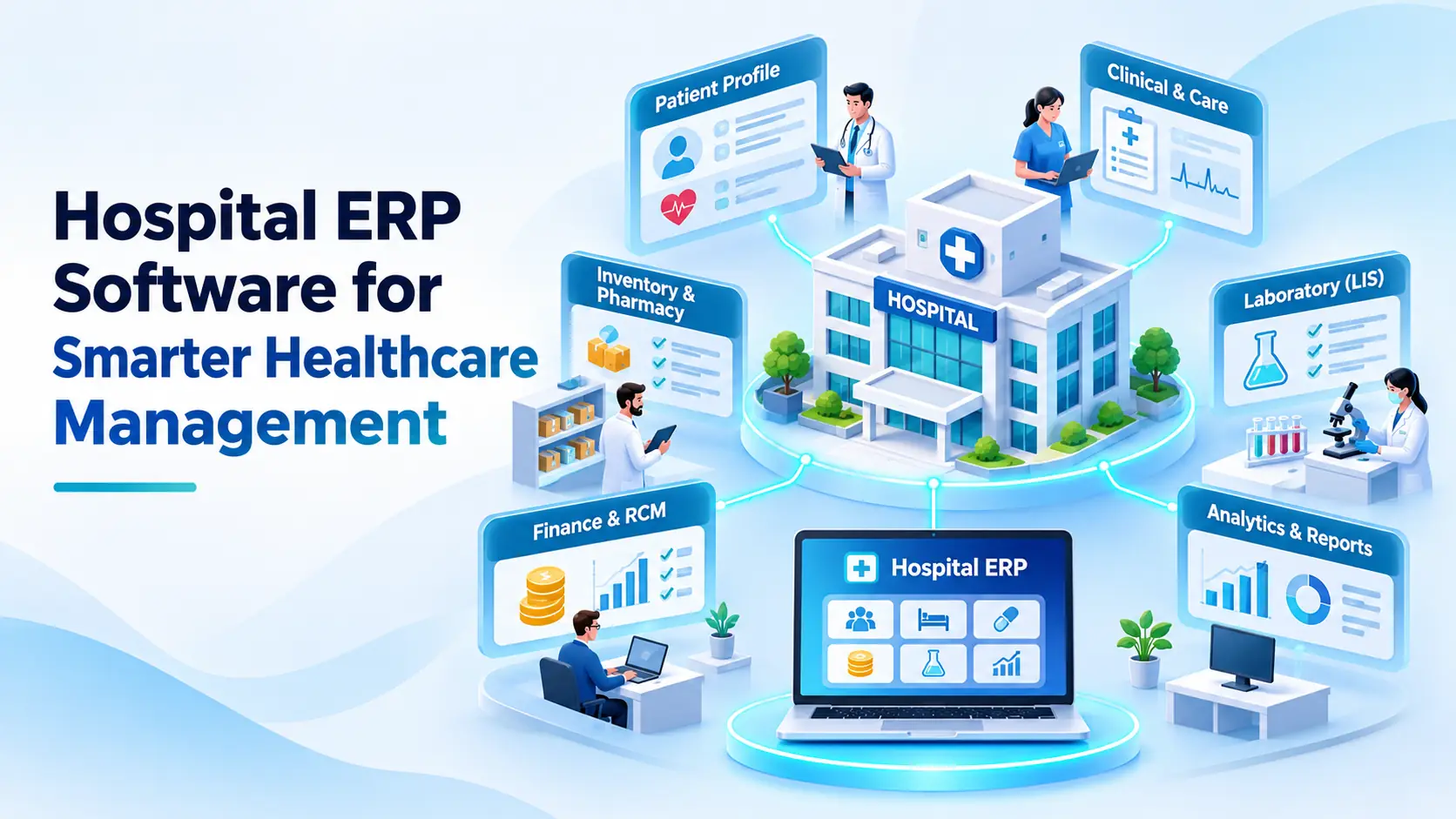
Hospital ERP Software for Smarter Healthcare Management
Connect hospital finance, procurement, inventory, pharmacy, billing and administrative operations through an integrated healthcare technology platform. HealthCluster brings enterprise hospital workflows together with EMR and HIS capabilities for healthcare organisations in the UAE.
Manage Hospital Resources, Finance and Operations in One Connected Environment
Hospitals manage multiple departments, resources, suppliers, financial activities and clinical services every day. When these functions operate through disconnected systems, administrators may struggle to maintain a consistent view of hospital operations.
Hospital ERP software helps connect business and administrative processes. When integrated with an HIS and EMR, it can link financial and operational activities with the clinical services delivered across the hospital.
- Manage financial and accounting workflows.
- Coordinate purchasing and supplier activities.
- Monitor inventory and stock movement.
- Connect pharmacy and healthcare operations.
- Organise billing and revenue cycle activities.
- Access operational and financial reporting.
Coordinate accounting, financial records and hospital business activities.
Organise purchasing requirements, purchase orders and supplier coordination.
Monitor stock records, item movement and inventory requirements.
Connect medication and pharmacy-related operational workflows.
Review financial and operational information for management.
Hospital ERP vs Hospital Information System: What’s the Difference?
Both systems support hospital management, but they focus on different business and healthcare workflows. An integrated environment connects the two.
| Business Area | Hospital ERP Focus | HIS / EMR Focus |
|---|---|---|
| Finance | Accounting and financial management | Patient billing and service charges |
| Procurement | Purchase orders and supplier processes | Clinical and departmental requisitions |
| Inventory | Stock and resource management | Clinical and pharmacy stock usage |
| Human Resources | Employee and workforce administration | Clinical staff workflow coordination |
| Patient Care | Business support for healthcare operations | Registration, OPD, IPD and EMR |
| Reporting | Financial and business reporting | Clinical and operational reporting |
An integrated hospital platform connects business operations with patient care processes, helping departments work with more consistent information.
Essential Hospital ERP Software Modules
Evaluate the business and operational modules your hospital needs to coordinate resources, financial activities and departmental processes.
Financial Management & Accounting
Organise financial transactions, accounting workflows, expense records and financial reporting for hospital administration.
Procurement Management
Coordinate purchase requests, purchase orders, suppliers, approvals and procurement activities.
Inventory Management
Manage inventory records, stock receipts, stock issues, transfers and stock monitoring.
Pharmacy Management
Support medication inventory, pharmacy operations and coordination with patient care workflows.
Human Resources Management
Organise employee information, staff records, department structures and workforce administration.
Billing & Revenue Cycle Management
Connect healthcare services with billing, insurance workflows, payment tracking and revenue reporting.
Explore Healthcare RCM →Asset Management
Evaluate equipment records, asset tracking, maintenance activities and resource allocation requirements.
Management Reporting
Review business activity, financial information, resource utilisation and operational reports.
Multi-Department Coordination
Connect relevant administrative and operational information across departments and hospital facilities.
Connect Hospital ERP With EMR and HIS Workflows
ERP manages important business processes. HIS and EMR support patient care and clinical operations. Connecting these systems can reduce information gaps between hospital departments.
HealthCluster offers an integrated healthcare technology environment covering hospital information systems, electronic medical records, revenue cycle management and related healthcare capabilities.
- Connect patient services with billing workflows.
- Coordinate pharmacy and inventory activities.
- Link clinical operations with financial processes.
- Review hospital-wide operational information.
- Evaluate integration requirements between modules.
Finance, procurement, inventory and administrative workflows.
Hospital departments, patient journeys and operational processes.
Patient profiles, clinical documentation and medical histories.
Billing, claims-related workflows and financial reporting.
How Hospital ERP Connects Departmental Operations
A connected workflow helps departments coordinate requests, approvals, resources and financial information.
Illustrative business process. Actual workflows depend on ERP configuration and organisational policies.
Hospital ERP Software for Healthcare Organisations in the UAE
Healthcare organisations in the UAE need to evaluate financial, administrative, clinical and integration requirements when selecting an enterprise healthcare platform.
Dubai
Evaluate hospital ERP, financial management and HIS requirements alongside applicable DHA and NABIDH integration considerations.
Abu Dhabi
Consider hospital operations, financial workflows and applicable DOH and Malaffi interoperability requirements.
Sharjah
Evaluate enterprise hospital management, resource planning and operational requirements for healthcare facilities.
Ajman
Review financial, inventory, administrative and clinical management requirements for healthcare organisations.
Ras Al Khaimah
Assess integrated healthcare operations and resource management requirements for hospitals and medical centres.
Fujairah & Umm Al Quwain
Evaluate scalable healthcare technology for clinical, administrative and financial operations.
How to Choose the Right Hospital ERP System
A hospital ERP decision should be based on the organisation’s business model, operational requirements and long-term technology strategy.
Check finance, procurement, inventory, pharmacy and other required functions.
Review how business workflows connect with clinical and patient information.
Evaluate accounting visibility, revenue reporting and financial processes.
Review role-based access, approval processes and audit requirements.
Assess purchasing workflows, supplier management and approvals.
Check stock movement, availability, transfers and reporting.
Review hosting, data protection, backups and disaster recovery.
Understand configuration, data migration, training and ongoing support.
Consider Regulatory and Healthcare Integration Requirements
Hospital ERP selection should consider the wider healthcare technology environment. Depending on the facility and emirate, your organisation may need to assess healthcare data exchange, insurance, billing, financial and information security requirements.
HealthCluster’s healthcare technology portfolio includes integration-related capabilities for UAE healthcare providers. The actual scope should be confirmed for the selected modules and facility.
- NABIDH requirements for applicable Dubai facilities.
- Malaffi requirements for applicable Abu Dhabi facilities.
- Riayati requirements where applicable.
- Healthcare billing and insurance workflows.
- Data security, access and audit considerations.
DHA and NABIDH requirements for applicable facilities.
DOH and Malaffi requirements for applicable facilities.
Relevant interoperability, security and operational requirements.
Discover the HealthCluster Healthcare Technology Ecosystem
Explore connected hospital management, electronic medical records, revenue cycle management and healthcare software solutions.
Hospital ERP Software FAQs
Common questions from healthcare leaders evaluating hospital ERP systems and integrated healthcare management platforms.
Hospital ERP software is an enterprise management platform designed to coordinate business and administrative processes within a healthcare organisation. Depending on the solution, it can cover finance, accounting, procurement, inventory, pharmacy, human resources and reporting.
Common hospital ERP modules include financial management, accounting, procurement, supplier management, inventory, pharmacy, human resources, asset management, billing and management reporting. Exact module coverage varies by vendor.
Hospital ERP focuses mainly on enterprise business operations such as finance, procurement and inventory. HIS focuses on hospital information and healthcare workflows such as patient registration, clinical documentation, OPD, IPD and departmental coordination. Integrated platforms can connect both.
Yes, depending on the platform and integration scope. An ERP system may connect with EMR workflows to link patient services, billing, inventory and other operational information. Confirm supported interfaces and workflows with the vendor.
Financial accounting is a common ERP capability. Healthcare organisations should evaluate general ledger, expense tracking, financial reporting and the accounting functions supported by the selected product configuration.
Many healthcare ERP systems support purchasing, purchase orders, supplier records, stock receipts, inventory transfers and stock monitoring. The available workflows depend on the software modules.
Hospital ERP software can support UAE healthcare organisations when its functions, integrations, security controls and implementation approach meet their requirements. Hospitals should assess applicable local healthcare, financial and information exchange obligations before selecting a system.
HealthCluster’s healthcare technology portfolio includes hospital information systems and business-related capabilities such as financial accounting, inventory, pharmacy and revenue cycle management. Confirm the specific ERP modules and configuration required for your hospital during a demonstration.
Hospital ERP pricing depends on the number of users, modules, facility size, branches, integrations, deployment model, customisation and implementation requirements. Request a tailored quotation based on your hospital’s needs.
Explore Healthcare Software Pricing →Visit the HealthCluster contact page and share your facility type, location, number of departments and required ERP modules. The team can discuss the relevant healthcare software configuration and demonstration.
Request a Hospital ERP Demo →Bring Your Hospital’s Business and Healthcare Operations Together
Explore an integrated healthcare technology platform for hospital finance, inventory, procurement, billing, EMR and HIS workflows. Discuss your organisation’s ERP requirements with HealthCluster.
Book Your Hospital ERP Demo →Module availability, integrations and implementation scope should be confirmed during product assessment.