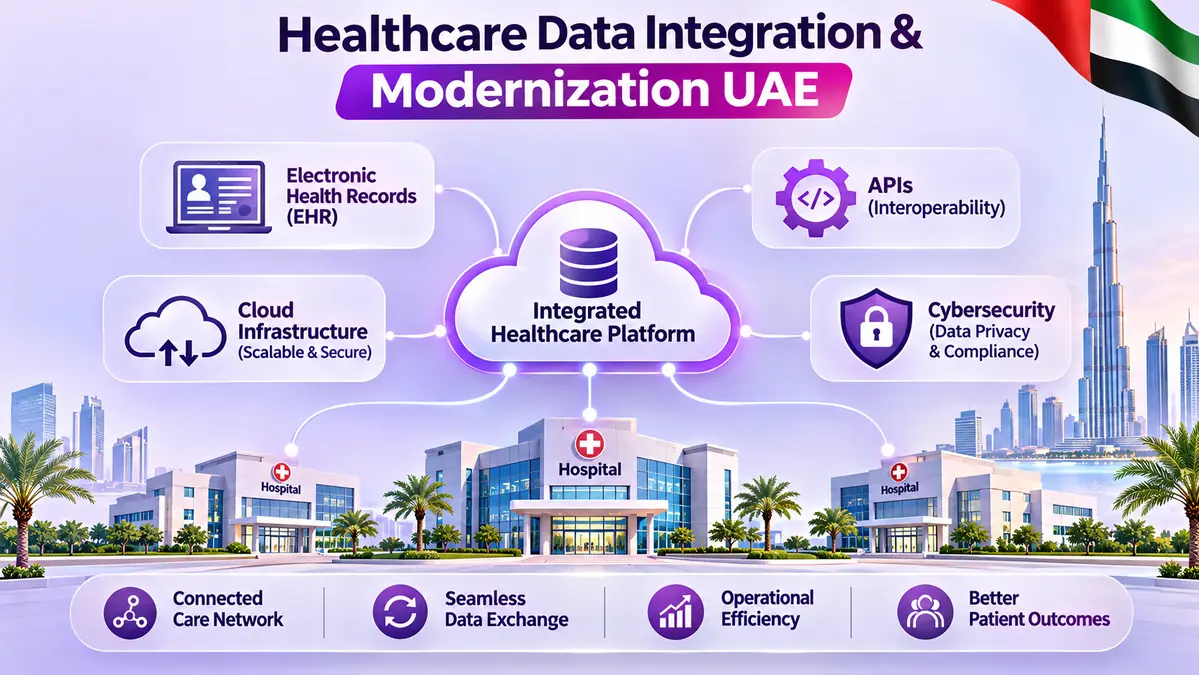
Healthcare Data Integration & Modernization Services UAE
Connect healthcare applications, modernise legacy systems and improve information exchange across your organisation. HealthCluster helps healthcare providers assess EMR, HIS, LIS, pharmacy, billing and hospital workflow integration requirements.
Healthcare data integration services connect EMR, HIS, LIS, pharmacy, billing and other healthcare applications so information can move between systems in a structured way. HealthCluster helps healthcare organisations assess connectivity, modernisation and workflow improvement requirements across Dubai, Abu Dhabi and the UAE.
Connect Disconnected Healthcare Systems and Improve Data Flow
Hospitals, clinics and diagnostic centres often depend on several applications to manage patient information, appointments, laboratory results, pharmacy operations and billing.
When these applications do not communicate effectively, healthcare teams may face repeated data entry, information gaps, delayed workflows and limited operational visibility.
Healthcare data integration helps organisations connect supported applications and establish more consistent information exchange. Modernisation projects can also improve the architecture and capabilities of existing healthcare applications.
- Connect EMR, HIS, LIS and other applications.
- Assess legacy healthcare software.
- Plan data migration and information mapping.
- Improve departmental information exchange.
- Identify hospital workflow automation opportunities.
- Evaluate healthcare interoperability requirements.
Assess how existing healthcare applications exchange information.
Identify data fields, structures, identifiers and validation requirements.
Evaluate existing applications and identify suitable upgrade or migration options.
Identify opportunities to connect manual and disconnected departmental processes.
Review relevant standards and technical exchange requirements.
Healthcare Data Integration and Modernization Services
Explore the key service areas healthcare organisations can assess when connecting applications, improving data exchange or planning digital transformation projects.
Healthcare System Integration
Assess and connect EMR, HIS, LIS, pharmacy, billing and third-party healthcare applications through supported interfaces.
Healthcare Application Modernization
Review legacy healthcare applications and identify opportunities for architecture improvements, upgrades and migration.
Healthcare Data Migration
Plan data extraction, mapping, transformation, validation and migration between supported healthcare systems.
Hospital Workflow Automation
Identify repetitive manual tasks and improve coordination between clinical, administrative and financial workflows.
Healthcare API Integration
Evaluate API connectivity and integration requirements for healthcare applications and external services.
Healthcare Interoperability
Assess information exchange requirements, data formats and interoperability considerations for healthcare organisations.
Modernise Existing Healthcare Applications Without Unnecessary Complexity
Healthcare application modernization is the process of improving existing software to support current operational, technical and business requirements.
It does not always require replacing every application. A targeted upgrade, integration layer, data migration or workflow improvement may be more suitable depending on the existing environment.
- Legacy EMR and HIS application assessment.
- Application architecture and technical review.
- Integration and interface planning.
- Data migration and validation planning.
- Scalability and performance considerations.
- Security and access management review.
Understand existing technology, limitations and business needs.
Review architecture, workflows, data and integration requirements.
Define suitable upgrades, interfaces, migration and implementation scope.
Review functionality, data quality and operational requirements.
Connect EMR, HIS, LIS, Pharmacy and Billing Applications
Healthcare integration connects systems that support different parts of the patient journey and hospital operation.
EMR and HIS Integration
Connect patient registration, appointments, clinical records, admissions and hospital workflows across supported applications.
Explore Hospital Information System →EMR and LIS Integration
Assess laboratory order communication, specimen workflows, result exchange and related patient information.
Pharmacy Integration
Evaluate medication-related workflows and information exchange between pharmacy and clinical applications.
Billing and RCM Integration
Connect clinical services with billing, invoices, insurance workflows and revenue cycle information.
Explore RCM Solutions →Third-Party Application Integration
Assess connectivity with external applications using supported APIs, interfaces and agreed technical methods.
Reporting and Data Exchange
Review information flows and reporting requirements across healthcare departments and applications.
Improve Information Flow Across Hospital Departments
Workflow automation starts by understanding where manual tasks, repeated data entry and disconnected applications affect daily healthcare operations.
Illustrative patient workflow. Actual automation depends on application capabilities and agreed implementation scope.
Healthcare Data Exchange and Integration Requirements in the UAE
Healthcare providers should evaluate relevant health information exchange requirements according to their emirate, facility type and applicable regulatory obligations.
Dubai: DHA and NABIDH
Dubai healthcare facilities should assess applicable DHA interoperability and NABIDH data exchange requirements, including technical connectivity and onboarding.
Abu Dhabi: DOH and Malaffi
Abu Dhabi healthcare providers should review relevant DOH requirements and Malaffi specifications for their facility.
UAE: MoHAP and Riayati
Healthcare facilities should assess applicable MoHAP and Riayati integration requirements for their organisation.
NABIDH, Malaffi and Riayati are health information exchange platforms. DHA, DOH and MoHAP are health authorities. Integration support, technical connectivity, facility onboarding and regulatory approval are separate matters. Each facility should confirm its obligations with the relevant authority or exchange operator.
A Structured Approach to Healthcare Integration Projects
Every healthcare integration project starts with understanding the current environment, identifying requirements and defining a practical implementation plan.
Discovery and Assessment
Review existing applications, departments, integration needs and business objectives.
Current-State Analysis
Assess interfaces, data structures, technical constraints and workflow gaps.
Integration Planning
Define architecture, interfaces, data flows, dependencies and project responsibilities.
Data Mapping and Validation
Identify data fields, identifiers, formats, validation rules and migration requirements.
Development and Testing
Implement agreed interfaces and validate information exchange, errors and expected workflows.
Deployment and Review
Plan go-live, user coordination, monitoring and post-deployment review within the agreed scope.
Healthcare Data Solutions for Different Healthcare Organisations
Integration and modernisation requirements differ by organisation. The right approach depends on current systems, data needs and operational objectives.
Hospitals and Hospital Groups
Connect hospital applications, clinical workflows, diagnostics, billing and administrative systems.
Clinics and Medical Centres
Assess patient information exchange, EMR connectivity, appointment and billing workflows.
Diagnostic and Laboratory Centres
Review laboratory application connectivity, order exchange, specimen workflows and result communication.
Healthcare IT Departments
Support application architecture review, interface planning, integration assessment and data migration planning.
Digital Transformation Teams
Identify opportunities to modernise applications and improve connected healthcare operations.
Healthcare Technology Providers
Evaluate third-party application connectivity and interoperability requirements.
Healthcare Integration Services Across the UAE
Healthcare organisations in different emirates may have different integration priorities, exchange requirements and technical environments.
Connected Healthcare Applications and Solutions
Explore HealthCluster’s healthcare technology portfolio and related solutions for connected healthcare operations.
Healthcare Data Integration and Modernization FAQs
Answers to common questions from healthcare organisations evaluating integration, interoperability and modernisation projects.
Healthcare data integration services connect EMR, HIS, LIS, pharmacy, billing and other healthcare applications so information can be exchanged between supported systems. They may include interface assessment, data mapping, integration planning and testing.
Healthcare data modernization improves how healthcare information is collected, stored, managed, exchanged and used. It may involve application upgrades, data migration, integration and workflow improvements.
Healthcare application modernization in the UAE involves assessing and improving existing healthcare software to support current clinical, operational, technical and interoperability requirements.
Hospitals can connect EMR, HIS and LIS applications through supported APIs, interface engines or agreed data exchange standards. The integration approach depends on the systems, data structures and required workflows.
Healthcare system integrators assess applications, define integration requirements, plan interfaces, coordinate data mapping, support implementation and test information exchange. Their responsibilities depend on the agreed project scope.
Healthcare interoperability is the ability of different healthcare systems to exchange and use information in a consistent and meaningful way. It supports information sharing between applications and healthcare providers.
Dubai hospitals should review applicable DHA and NABIDH interoperability and data exchange requirements. They should also assess patient identification, data quality, technical connectivity, security and facility onboarding obligations.
Healthcare providers in Abu Dhabi should review applicable Department of Health requirements and Malaffi specifications. Requirements depend on facility type, exchange scope and applicable implementation obligations.
In some cases, yes. Targeted upgrades, interfaces, data migration or workflow improvements may address specific limitations. A technical assessment helps determine whether integration, modernisation or replacement is most suitable.
Share your organisation’s location, existing applications, integration requirements and main operational challenges. HealthCluster can discuss the relevant solution areas and potential project scope.
Contact HealthCluster →Ready to Connect and Modernise Your Healthcare Technology?
Discuss your EMR, HIS, LIS, healthcare data exchange and application modernisation requirements with HealthCluster. Start with a conversation about your current systems and integration objectives.
Request an Integration Assessment →Technical feasibility, integrations, standards and implementation scope are subject to assessment and agreement.